

Developing Your Own Symbolic Language
On creating meaning and giving the middle finger to tasteslop

I recently rewatched Arrival (for like the 10th time). The idea of reshaping your brain through language is something that has always fascinated me, and there’s mounting evidence showing that it’s legit! Take it from me, a Mexican born Canadian “raised” fella: I used to think that speaking two languages only meant that I could serve double the sass, but it’s actually more than that.
Speaking two languages and, actively belonging to two different cultures, has deeply shaped who I am as a human and a creative. It has given me two diverse ways to experience and interpret the world around me. Not only can I now serve double the sass, but I can also experience two takes on anything.
Language is an immensely power tool that ai continuously struggles to fully replicate (no matter what the tech bros want us to believe). This avalanche of faux-replicant language has created what we all now know as slop. Slop to me is the unfortunate (but logical) result of nurturing dupe culture for far too long (the culture of imitation for the sake of it). You know the drill: same Pinterest boards, same campaign inspiration, same interior aesthetic, same fits, bla bla. Slop is the overall term that covers all of it (images, text, video) but now we have an even more specific term related to the topic I’m covering: tasteslop.
Tastelop is honestly a genius term. It encapsulates everything that’s wrong with the current way of creating, which is heavily influenced by the flattening powers of the algorithm and brands with no core or personality.
Tasteslop is the result of a massive lack of meaning.
Our curiosity, experimentation, relationships, POVs - basically any lived experience - is what shapes our personality and language so we can communicate meaning. Without meaning, we are just a repetitive dull line of code worshipping the algo.
Just think about it: how can we truly express our identity if we lack meaning? How can we articulate anything if we lack the proper language? And how can we create our own language if we don’t have any symbols?
Having a distinct symbolic language that is full of character is one of the top creative abilities we need to develop. Developing this ability now is more important than ever, especially in the advent of portfolio careers.
When chatting about work, a question that always comes up is: “How do you transmute your taste into a project over and over again without losing yourself?” The generic answer tends to be: “Just do you!” But that approach is very reductive. How can you “do you”, if you don’t know who you are and what you stand for?
At work, people don’t hire me to turn them into a copy of myself. They hire me to help them shape and articulate their own creative language to communicate who they are, regardless if they are a brand or an individual. They see my work (which covers different mediums) and understand the connection and meaning, they can’t describe it, but they can absolutely feel it. And THAT right there is the power of an established symbolic language.
Gone are the days when the “one-size fits all” agency template made sense (or worked). Time and time again I get inquiries from people who went through a big agency process (spending shit tons of money) and ended up with a stale result that feels nothing like them. Their feedback is always “This isn’t us! This feels like a generic template with a sprinkle of us on top” Boo, you are not a sprinkle — you are the whole cake!
People and brands are tired of conforming to tastelop — they want out! They can feel it, but they cannot articulate it. They know a template approach is not gonna work.
So…. how can we help anyone articulate meaning if we don’t have a system in place?
This where a well-developed symbolic language comes out to win. It’s not about words, mood boards, or vibes - those are just vessels (and sometimes distractions). What we actually need is strategy and action to transmute meaning into reality. Into something you can feel, see, touch and experience. It’s what creates the “I can feel it! But I cannot explain it” emotional connection that draws people in.
To find that strategy, the “doing”, you need to draw the essence out of things.
Let me approach this like animist: everything has a soul, and our task is to find it so we can “see” beyond its material representation so we can tap into its essence. This essence is what will help us shape a symbol; not to use it as a mechanical stamp, but to use as it as part of system that communicates meaning.
To land this concept and to put it in practice, here’s an example of how I use my own symbols at work: a symbol of mine is heroine. The symbol of heroine is heavily influenced by cartoons I watched as a kid: She-Ra, Sailor Moon, Jem and the Holograms, and my absolute favourite: Minky Momo. My personal meaning of heroine, the essence I drew from it, is fantasy, magic, adaptation, and inner power. The way I symbolize it in my work is through colour: pastel blue, dusty pink, and soft purple or lilac.
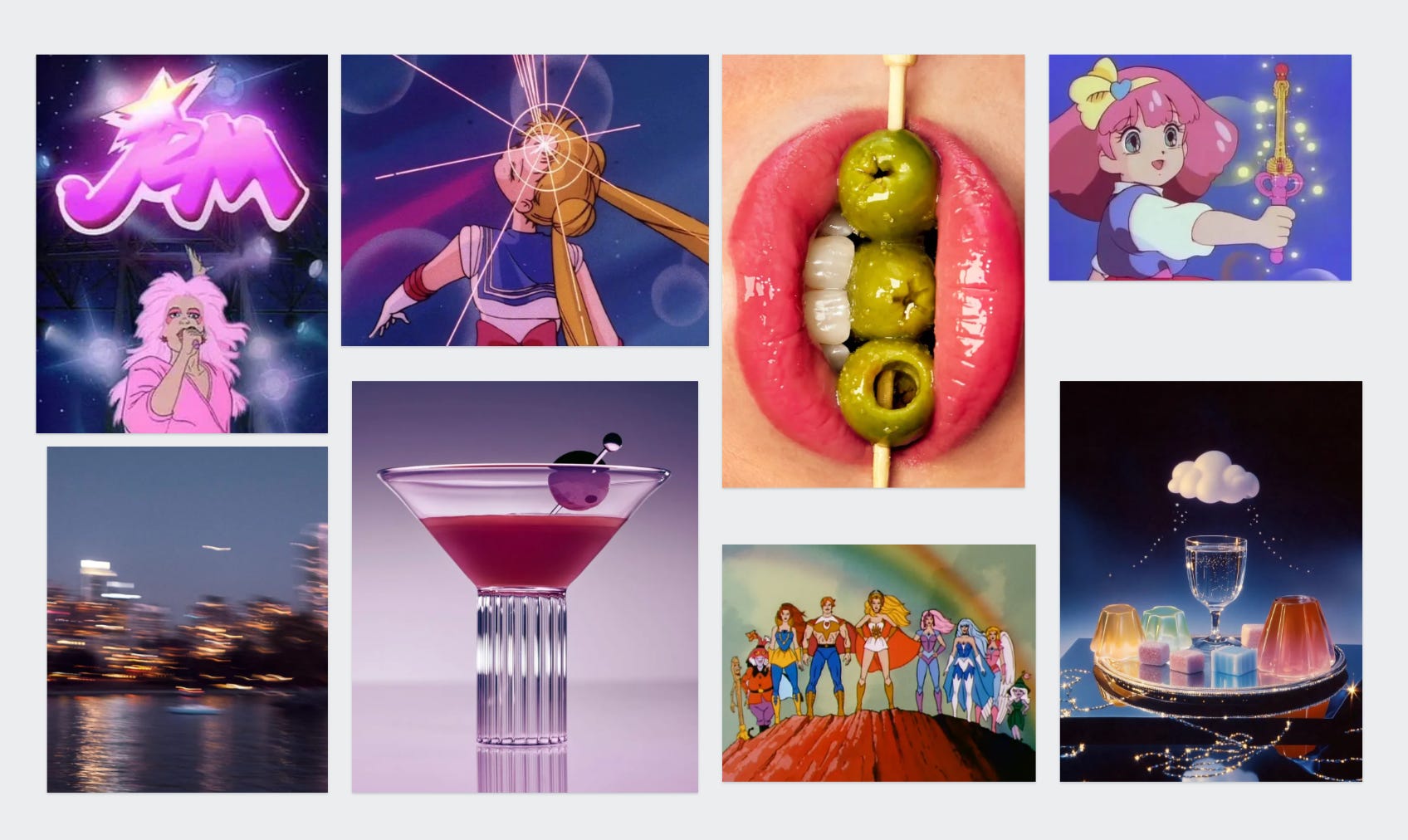
The ratio of these colours is dependant on the level of meaning that needs to be communicated (I think of it as dialling up or down the intensity). Sometimes I get to dial it all the way up (mostly on personal projects), sometimes I only add a touch of it (mostly on commercial projects).
The point here is not to develop a formulaic approach that can be replicated over and over again, but rather, to create the prime material I can shape into any given project or medium.
These symbols are like words, and you can arrange them in sentences to create paragraphs. When put together over time, they create a full body of work. One that feels cohesive.
If all you are doing is to borrow symbolic references from someone else (aka following the tasteslop), then what are you saying? Are you communicating personal meaning? No you are not; you are effectively broadcasting someone else’s message, always. Like a broken radio picking up random signals and noise.
In the movie Arrival, Amy Adams’ character is able to experience time in a non-linear way - all because she learned the hectapod language. Call me crazy, but when you develop and use your own symbolic language, a similar thing takes place in your brain. All of the sudden your imagination is able to experience an idea in many different ways! I cannot tell you how insanely useful this is, and how many times it has saved my ass (especially during dry creative spells, when nothing “good” comes out).
It’s like having a compass that — no matter the medium, project, or context — will guide you so you don’t lose yourself in the tasteslop. In fact it’s the opposite: it allows you to pick up new goodies along the way to create new symbols, like an expansive organic system.
The coolest thing about a personal symbolic language is that no algorithm can ever fully replicate it. Your personal chaos, and how you arrange it, works like a creative fingerprint.
Everything from falling in love, to getting your heart broken, to plunging into debt, to scoring a dream client, to traveling, to hanging out with friends. All of it acts as the raw elements waiting to be mixed to create the clay that will shape your symbolic language.
If you want to dive into creating your language and don’t know where to start, go watch Arrival and get inspired! Or better yet, go experience something new.
Until next time!
Gab
As a multilingual person, this resonated so deeply with me